Saturday, 17 October 2015

SEO Optimization tips and tricks in 2015 - 16

SEO

In the early days of the internet, SEO optimization was easy.

-Pick out the keyword you want to rank.

-Pump out content with your keyword laced generously throughout your page, including in your title and meta tags.

-Add in a few backlinks.


Chances were good that your content would rank! Then the search engines got smart.

In 2014 and beyond, content marketing is becoming the backbone of SEO. What’s the difference from old school SEO versus SEO optimization 2014+ style?

Below, we’re sharing an SEO infographic. It’s a look the strategies that used to define SEO and those you need to use today in order to drive organic search rankings and avoid future search engine penalties.


Mindset

- Focus more on how people engage with a particular brand, product and services.

- ROI Focused.

- Analytics, Content Creation, Social media marketing and then keyword research .


Keywords


- Focus on keyword intent and search user needs

- Focus on long tail searches

- 70 Prcent of search traffic comes from long tail keywords

- Focus on conversion rate and performance metrics


Content


- Create Content to Provide real value to the audience

- Focus on audience, it will attract

- Based on the Survey of 400+ company by Econsultancy 45% of companies say content Marketing is "Highly integrated" with their strategy.


Link Building


- Only Quality Backlinks will work.

- Most Quality backlinks can be built with relationship building


SEO Key Takeaways

Make sure that content marketing is the backbone of your SEO strategy:

-You must make sure your content is valuable, easy to read, and focused on topics your users care about.

-Long-tail keywords will usually result in better engagement.

-Avoid spammy backlinks. Seek out only high-quality, natural link opportunities.


Thursday, 8 October 2015

Top 5 White Hat and Black Hat Search Engine Optimisation Techniques

Top 5 White Hat and Black Hat SEO Techniques


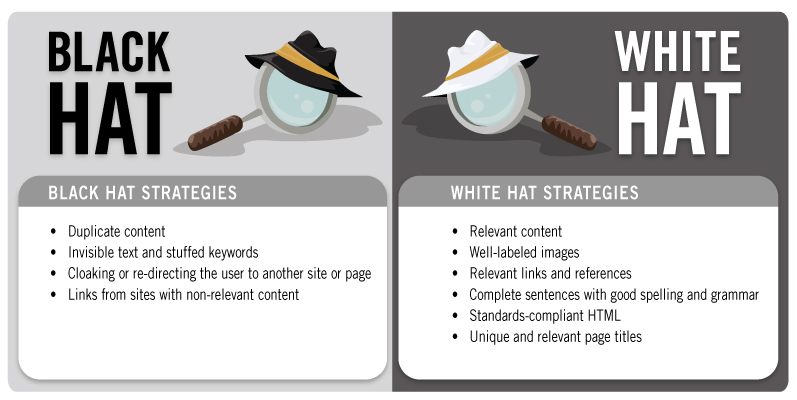
Search engine optimisation, as with all things in life has a good, wholesome, fair and right way of doing things and a bad, unfair, downright naughty way of doing things. To describe the two SEO methodologies the terms “White Hat” and “Black Hat” SEO were coined.

We sit very firmly in the white hat camp believing that while black hat SEO techniques might have some short term positive effect, the long term implications can be disastrous for your website and in turn your business.


In this article we’ll examine the top 5 black hat SEO techniques in a bid to help you determine whether the SEO firm you’re currently using are potentially compromising your business website. Then we’ll examine the top 5 white hat SEO techniques that we believe will have a positive effect on your search position without putting your business website at risk.


TOP 5 BLACK HAT SEO TECHNIQUES


1. Hidden Content


Top of our list of black hat SEO techniques is hidden content. Hidden content comes in many guises but the basic principle is that within the code for the site there will be content stuffed with keywords, this content will not be visible to the end user of the site.


One way of doing this is by using comment tags.

Comment tags look like this;

<!– Comment Tag –>

The real purpose of comment tags is for developers to add in useful reminders within their code explaining what that piece of code does.

Here’s an example of the comment tag being used correctly,

<!– Start of the Main Content –>

Here’s an example of a comment tag being used incorrectly in a bid to promote a hypothetical page targeting search engine optimisation,

<!—Search engine optimisation, SEO, professional search engine optimisation company, spamming search engines –->

Another popular way of hiding content is the use of the <noscript> tag. The <noscript> tag should be used to inform a user that a script is being used but their browser either doesn’t support the script

language used or they have that function turned off.

Here’s an example of the <noscript> tag being used correctly,

&ltscript type=”text/javascript”>

<!– document.write(“Hello World!”) //–>

</script><br />

<noscript>Your browser does not support JavaScript!</noscript>

Here’s an example of the <noscript> tag being used as a black hat SEO technique again in a bid to promote a hypothetical page but this time targeting car hire,

<noscript>

Imaginary Car Hire Firm do Car Hire which is very affordable so if you want to hire a car call our car hire firm because we are the best car hire firm in the world

</noscript>

Other HMTL tags misused in similar ways include the <noframes> tag and hidden inputs in forms.

Content can also be hidden from the end user by using CSS, excessively small text and coloured text on the same coloured background.

All of these techniques are frowned upon by search engines and if detected can mean your website will be penalised or even banned. To the untrained eye it can be very difficult to spot the use of some of these techniques which is why we offer a free website MOT test at PushON.


2. Meta Keyword Stuffing


There are two Meta tags that are generally used to inform search engines of the content on the page. They reside between the <head> tag of a page and when used incorrectly they can alert a search engine that a site is using spam techniques in an attempt to improve its ranking.

Meta Description

The meta description should be used to describe the content of your page honestly and concisely and be 1 or 2 sentences, 3 at most.

Here’s an example of the meta description being used in the correct manner,

<meta name=”description” content=”PushON are an Online Marketing agency providing a full range of digital marketing services throughout Greater Manchester and the North West UK. If you need Search Engine marketing (SEM), Search Engine Optimisation (SEO) or Pay per Click (PPC), we can help you. Contact us now.” />

Here’s an example of the meta description tag being used incorrectly for a page promoting a restaurant called “MadeUp”,

<meta name=”description” content=”MadeUp restaurant website is the best MadeUp restaurant website, our restaurant is better than any restaurant,great restaurant,best food restaurant,visit our restaurant” />


3. Meta Keywords


Meta Keywords should be a short list of words that inform of the main focus of the page. Meta keywords have been so misused in the past that there are few if any search engines that take any heed of them.

Here’s an example of the meta keywords being used in the correct manner,

<meta name=”Keywords” content=”Online marketing, digital marketing, search marketing, search engine marketing, e-mail marketing, SEO” />

Here’s an example of the meta keywords tag being used incorrectly for a page promoting a restaurant called “MadeUp”,

<meta name=”keywords” content=”Restaurant,restaurants,food,feed,take away food,fast food,junk food,eat,eating out,dinner,dining,meal,eating,MadeUp,steak and chips,chicken and chips,pie and chips,pudding,desert,big restaurant,small restaurant,best restaurant,great restaurant, exclusive restaurant,cocktails,wine,drink,pizza,sandwhiches”>


4. Doorway or Gateway Pages


Doorway or Gateway pages are pages designed for search engines and not for the end user. They are basically fake pages that are stuffed with content and highly optimised for 1 or 2 keywords that link to a target or landing page. The end user never sees these pages because they are automatically redirected to the target page.

Off-the-shelf SEO software often encourages the use of gateway pages as do SEO firms that don’t know what they’re talking about. Search engine spiders are being enhanced continually to detect these pages and will get ignored or worse still, flag your site up as being spam and ban you all together.


5. Link Farming

In the real world if you were to build your house in a bad neighbour hood then your house would be affected by its surroundings. The same is true of the virtual world. Link farms or free for all (FFA) pages have no other purposes than to list links of unrelated websites. They won’t provide you with any traffic and you run the risk of having your site banned for participating. Don’t participate in link farming.


TOP 5 WHITE HAT SEO TECHNIQUES


1. Quality Content


When we first started looking at SEO as a separate entity to website build there was one phrase that we would continually hear, “content is King”, and it’s true. There is nothing more valuable you can do to optimise your site for search engines than offer unique well written content. A search engines aim is to serve up what it believes to be the most appropriate website for any given search to the end user.

Imagine we are the end user and we are searching for a portable air conditioner for hire. We go to our favourite search engine and search for the phrase “portable air conditioner hire”. In this imaginary scenario let’s assume there are only 2 websites that target that phrase,


Website 1


Website 1 consists of a single page with 3 paragraphs of text. The text tells us that the company does portable air conditioning hire and give us a phone number to call.


Website 2


Website 2 contains 30 plus pages all focusing on various portable air conditioning units that we can hire, costs and technical explanations of how portable air conditioning units work.

Which website do you think the search engine is likely to offer to the user first? It’s a rather obvious example but it illustrates the importance of good content so your priority should be good quality content.


2. Use Structural (Semantic) Mark Up and Separate Content from Presentation


Semantically structuring your mark up helps search engines understand the content of your webpage which is of course a good thing. Making proper use of heading elements is essential because search engines give more weight

to the content within the heading elements.

Using CSS to separate the design elements from the content makes for much leaner code and makes it easier for search engines to find what they’re looking for, which is content. Remember content is king!


3. Titles and Meta Data


Providing pages with proper titles and meta data is essential. As discussed in the top 5 black hat SEO techniques section the meta description and meta keywords elements have been so misused in the past that Search

Engines now regard them as less important, it’s still important to use them and use them properly. Titles however still carry a lot of weight and when we think of semantic mark up it is obvious why. The title of anything is a declaration as to what the content might be, so make sure your page titles are a true representation of the content of the page.


4. Keyword Research and Effective Keyword Use


Create your website with keywords and key phrases in mind. Research keywords and key phrases you think people might use to find your site. Single words are not always the most effective target, try multi-word phrases that are much more specific to your product/service and you’ll be targeting end users that are much more likely to want what you are offering.

Use the keywords and key phrases you’ve identified effectively throughout your website. Assign each page 2-3 of the keywords you’ve identified and use the keywords throughout all the important elements of the page. Those are,


Title
Meta Description
Meta Keywords
Heading Elements
<H1>
<H2>
<H2>...
Text
Alt Tag
Title Tag
Links


5. Quality Inbound Links


Having inbound links to your website can be likened to having a vote for the good but there are good links and bad links so therefore votes for the good and votes that are bad. Good links are links from other web pages

that are regarded highly by the search engines and are contextually relevant to the content of your page. Bad links are links from web pages that aren’t regarded highly or potentially banned by search engines and have no relevance to the content of your page.

For example;

Imagine we have a website that sells telephones.


Link A: Link on the homepage of the British Telecoms website. = Good

Link B: Link on John Smiths Beer and Ale appreciation links page = Bad


The amount of quality inbound links to your site therefore have some relevance on how high up the search engine your site is placed. When sourcing links you should be thinking of quality over quantity and deep linking to pages within your website not just the home page.


Source content : Google.com .... Thanks.


Wednesday, 23 September 2015

Facebook Marketing Strategy - Social media marketing Strategies 2015

Facebook Marketing Strategy - Social media marketing Strategies 2015

Facebook is the world’s largest social media network with a shopping 900 million + active users. It is feasible for businesses to market their products and services on Facebook. Following a marketing strategy that could earn reasonable results would be a dream come true. This post would discuss the essentials of Facebook Marketing Strategy.
Facebook Marketing Strategy with measurable results


Why Choose Facebook?
You should choose Facebook as it is the world’s most accessed Social media. It has its presence in over 213 countries of the world with people accessing the social platform from Europe,Asia, NorthAmerica,South America,Africa and Australia. Marketers can make use of enormous data available on Facebook which includes geographical location,interests,Gender,mobile users etc. Where else can you find such a vast amount of user data compiled by locations and interests? It is the most preferred source of marketing channel for businesses.

Facebook Marketing
Facebook Marketing
(Image Source:- Webmasteradvance)


The Facebook Platform
Launched in February 2004, and created by Marc Zuckerberg, Eduardo Saverin, Andrew Mc Collum, Dustin Moskowitz and Chris Hughes;Facebook has since became one of the most accessed site on the internet. Initially started as a networking platform for Harvard Students, Facebook has grown into a full fledged social networking site providing users a good platform to share their content which may include text, images, videos and other media.

Facebook gives you the ability to create your profile and start making friends. The platform has options for creating Pages, Groups and Events. You can use these channels to promote your products and services.


Create Notes for your Marketing Plan
Before any campaign is started, proper forecasting should be done. You need to prepare notes for your marketing plan in order to implement it successfully. Some questions which you need to answer are given below:-
1-      What are your business goals?
2-      Who are your audience?
3-      What is your target market?
4-      Do you want to build your online reputation?
5-      Do you want to increase your brand awareness?
6-      What are your business keywords?
7-      What are your conversion channels?
8-      What is your online advertising budget?
9-      What does your Fans like the most?
10-   How to integrate applications with Facebook Pages?
11-  Which applications can help you in the smooth flow of your communications?

Creating a Facebook Page

You must have a Facebook Profile, before you can create a Facebook Page. If you have a profile, then you must visit any Facebook Page and click on Create a Page to get a page for your business. Here are the steps to creating a Page:-


1-      Log in to Facebook and visit:- www.facebook.com/pages/create.php

2-      Choose a category for your page.

3-      Add any image or your company logo.

4-      Add some info about your company or business.

5-      Start updating your status.

Creating Facebook Groups or Events


1-      Log in to Facebook.

2-       Click on “Create a group” after visiting any existing group on Facebook.

3-      Name your group

4-      Invite your friends to your group.
5-      Check “Open” if you want to let anyone see the contents of the group else choose closed or secret.
6-      Provide a description for your group.
7-      Provide a name for the email id.
8-      Upload photo and choose category.
9-      You are ready to invite other members and start your discussion.


Adding Applications to your Page

Facebook provides you with innumerable applications which you may use for the success of your business.
Getting Likes for your Fan Page


Top 10 Strategies
1-Know your audience- The very first step in successful marketing strategy is knowing your audience. Facebook provides you with data where you can easily find out your ideal audience to target based on the georgraphical location, gender, age and interests.

2- Create a nice Landing Page- Remember, your targeted audiences would visit your Facebook Page to know more about your company and its products or services. Having a nice landing page would make them understand your company in a better way. The motto of “First impression is the last impression” would work best here.

3- Post Quality Content- Your fans have liked you because they think you are a source of useful information about their interests. It’s your responsibility to share constant updates about your company’s products, various activities, images, content and any other media which your fans may find interesting.

4- Turn on Discussions- Every post created by you should have some scope for further discussions. The more discussions, the more user engagement and the more user engagement, the more the chances of your page coming in the eyes of new audiences to increase your target market.

5- Keep your fans engaged- Start a contest and let your fans remain engaged with your brand in one way or the other.

6- Get more Likes- This is the measure of the popularity of the business. Hence, getting more likes adds to the reputation and popularity of the business.

7- Use Applications- These are your real friends in the online world of marketing. Your business pages needs them to actively promote your services infront of your audiences.

8- Follow Ettiquettes- You must follow several social media ettiquettes while prmoting your brand on these popular social marketing channels.

9- Daily Hour Approach- You must spend at least one hour of your time on a daily basis to promote your serives. This daily hour approach can go a long time to popularize your brand.

10- Maintaining the Edgerank- Edgerank is similar to Google's Pagrank and it measures the post popularity. You need to keep an eye on the Edgerank in order to gain more visibility in front of your targeted audiences. Edgerank depends upon time decay factor, weight factor and the engagement factor.

11- Measuring the Success- The last but not the least is the measurement of the success of the campaign. There are several online tools which can help you to measure the audience engagement and finally your return on investment (ROI). This is important as the money spent should be taken care of and the full utilization should be made.


Source : seosandwitch.com  thnaks.....

Tuesday, 28 July 2015

Ethical SEO vs. Unethical SEO Techniques in 2015 - SEO Tricks

SEO practices are rapidly making waves in the World Wide Web. As a tool for best optimising a website, SEO has accomplished a following of businesses that use ethical and unethical practices.
SEO (Search Engine Optimisation) Practice & Techniques
SEO is an effective brand awareness tool that enables online companies to market themselves within their own competitive business industries. SEO is all about ranking on major search engines (Google, MSN, Yahoo etc). The higher a website’s ranking, the more traffic and potential business dealings can be successfully generated. SEO is also a tool companies can use to “serve their customers”, giving them exactly what they want, when they want it.
The whole idea of SEO relates to how a target audience searches for information, products and services online. Searches are broken down into keywords. Sufficiently used keywords increase rankings. If a website uses keywords and phrases that match an online user’s search breakdowns, a company has an increased chance of better targeting their audience.
Methods of creating a winning SEO formula that best achieves this can be “honest” (ethical) or “dishonest” (unethical). The main difference between the two is quite simple: one follows generally accepted techniques and the other does not. What, then, is ethical SEO and unethical SEO?
What is Ethical SEO?
Ethical SEO is often referred to as “white hat” and is generally used to describe the use of accepted search engine optimisation techniques or code of conduct. Ethical SEO techniques are generally considered as those that can are clearly visible or obvious to a website visitor. Any hidden tricks are usually indicative of a hidden agenda.
What is Unethical SEO?
In contrast, unethical SEO is often referred to as “black hat” or “spam”. Unethical SEO is not necessarily an illegal activity, but is regarded as “below the belt”. Techniques and practices are frowned upon as manipulative and sneaky. In a sense, unethical SEO is all about cutting corners and cheating the accepted code of conduct. Unethical SEO has one essential goal: to achieve immediate or short term ranking results. A great way for an online user to almost instantly recognise unethical SEO methods is to determine the number of links a website uses, as well as their quality.
Unethical SEO practices and techniques are not usually obvious to a visitor. Website companies who make use of unethical techniques in order to achieve high search engine ranking rates by “tricking” the market can be banned or black listed from all major search engines.
Ethical SEO Practices
The following SEO practices and techniques are considered ethical:
  • Different links for separate website pages can be created
  • Keywords and content that is used is information that is relevant to a website visitor
  • Inbound links (links within a website) can be created. These can be useful if advertising through a social media website.
  • Websites can be updated regularly with relevant information. These can take the form of press releases, articles and / or blogs.
  • Keeping up to date with the types of keywords a target audience is consistently using. This way, keywords within content are built to cater for a customer or client, achieving better rankings, as well as giving a website more credibility. Using keywords properly and sufficiently encourages a target audience to regard and remember a website as being reliable for the information that they seek.
  • Links are not exchanged with other websites of a low quality or containing information that is not relevant to a targeted audience.
  • Adding a sitemap to a website can be easily found by search engine spiders and helps to better index the entire site.
Unethical SEO Practices
The following SEO practices and techniques are considered unethical:
  • Text is hidden – e.g.: white text is “hidden” on a white background, text can be “hidden” behind images or a size zero font can be used.
  • Links are hidden or made to appear less obvious so to a website visitor – e.g.: links can be made into the same font colour as the main content.
  • Making use of automated queries without the permission from search engines.
  • A method of “cloaking” is used whereby content is submitted to search engines in such a way that some text is not clearly obvious or apparent to a targeted audience.
  • Too many keywords and hidden text are used on a website. This is known as keyword stuffing. Online users are generally not appreciative of this.
  • Javascript re-directs can be used whereby search engines are directed to a web page that is different from the one that is expected.
  • Using duplicated content.
  • Exploiting security whereby viruses or badware can be installed the moment a website or page is opened by a user.
  • Trading links – many websites have a habit of trading links. This can be very misleading and disruptive to an online user.
  • Creating false doorway passages to direct users to other websites that may contain irrelevant content or a collection of more links.
  • Plagiarising or using auto-generated content with a high keyword density
In Conclusion
The internet market place is rife with competition. Every possibly business industry that you can think of is virtually competing online. Marketing tools are an essential means of the success that can or cannot be achieved. SEO is one such practice that can be used to better market a website, as well as its products and services by means of clever brand awareness. In practice, using SEO techniques can be done “honestly” or not as either ethical or unethical.

Tuesday, 24 March 2015

An update on doorway pages 2015

Google's Search Quality group is constantly taking a shot at routes in which to minimize the effect of webspam on clients. This incorporates entryway pages.

We have a long-standing view that entryway pages that are made exclusively for internet searchers can hurt the nature of the client's hunt experience.

Case in point, searchers may get a rundown of results that all go to the same site. So if a client clicks on one outcome, doesn't care for it, and after that tries the following result in the query items page and is taken to that same site that they didn't care for, that is a truly disappointing background.
Over the long haul, we've seen locales attempt to boost their "hunt foot shaped impression" without including clear, extraordinary quality. These entryway battles show themselves as pages on a site, as various spaces, or a blend thereof. To enhance the nature of list items for our clients, we'll soon dispatch a positioning conformity to better address these sorts of pages. Locales with vast and entrenched entryway battles may see an expansive effect from this change.

To help website admins better comprehend our rules, we've included elucidating illustrations and refreshed our meaning of entryway pages in our Quality Guidelines.


Here are things to ask of pages that could be seen as entryway pages:

·       1.  Is the reason to upgrade for web crawlers and pipe guests into the genuine usable or pertinent bit of your webpage, or would they say they are a vital piece of your website's client experience?

·        2. Are the pages proposed to rank on bland terms yet the substance exhibited on the page is certain?

·        3. Do the pages copy helpful conglomerations of things (areas, items, and so forth.) that as of now exist on the site with the end goal of catching more inquiry activity?

·        4. Are these pages made exclusively for drawing associate movement and sending clients along without making one of a kind esteem in substance or usefulness?

·        5. Do these pages exist as an "island?" Are they troublesome or difficult to explore to from different parts of your site? Are connections to such pages from different pages inside the site or system of locales made only for web crawlers?

·        6. On the off chance that you have inquiries or criticism about entryway pages, please visit our website admin help gathering.

Thursday, 4 December 2014

The 9 Worst SEO Tips For 2015 - Best SEO tricks in 2015

It’s that time of year again. I’m looking at the quotes telling me how the “universe” is going to help me fulfil my business ambitions – if only I believe. I’ve seen the photos of Richard Branson smiling and saying “it’s really not about money”.

Unfortunately the universe will not make you money from the Internet. A positive mental attitude will not make you money from the Internet – and neither will Richard Branson.

So you find yourself looking at the blog you last updated in June 2013 and think this year is going to be different than all the other years when you really could not be arsed with it all.

There’s just one problem, your website is not on page one when you search. Heck it’s not even close, even though you have been trying to get it there for months. You look on at your competitors and think, they don’t deserve to be there. Why the fuck is Google giving them a high rank and not me?

The reality is Google doesn’t always play fair and it won’t in 2015, so what do you do? You could always look at these 9 ways to cheat.


1.       Stuff your website with keywords  

Stuff your web pages with keywords. Mention that keyword in every sentence to make your content look as natural as a penguin riding a camel in a desert (more on penguin and stuffing later). It’s not about your website visitor it’s about you and getting your website to the top with a load of indecipherable babble.  Fake interviews, made up case studies or testimonials from your imaginary friends – Knock yourself out and just make it all up. Your visitors won’t understand what you’re going on about but what do you care?


2.       Build thousands of unnatural looking links

Everyone knows how important link building is. This is why you should get hold of as many links as you can. Better still, use one of the many automated services out there that will get hold of thousands for you cheaply. That way you won’t need to spend time writing useful content and getting authority sites to pass on useful link juice. Link juice to you is like carrot juice – not worth the time or effort.

You would rather upset Google’s penguin, which is not some cuddly creature you imagined from that kids movie Happy Feet. Oh no, this penguin is your worst nightmare because it gets your website penalised for unnatural looking links.  


3.       Write useless blogs just for the SEO benefit

Keep posting content on your blog because someone you know told you to. It doesn’t matter if it’s any good, just post the crap anyway because content is king. Even if nobody is reading it, the search engines will. If you can’t be bothered to write it yourself, get someone on Elance or Odesk to do it for you for a dollar an hour in their second language. They will love you for it because they would rather spend time writing crap for you than cleaning it from toilets in their second job (which actually pays them better).


4.       Steal content from other websites  

The easy way to get content on your website is to steal it. The BBC, Telegraph, Sky News to name but a few will have plenty of news you can copy and paste onto your blog. At the end of the day news is news so what’s the point in giving your own perspective on things when somebody has already spent hours of their time researching it for you?


5.       Add duplicate titles to all your pages

You want to rank for ‘Hairdressers Burnley’ so you give every page of your website this one title. Surely one of them will be on page one this year.


6.       Write press releases and keyword stuff them

Press release distribution services are great for backlinks. You can write a press release about nothing in particular and stuff it with keywords that point directly back to your website. This content might even get syndicated amongst a whole bunch of other low grade websites diluting your own authority even further and making your website look spammy.


7.       Be fixated on keywords

Google  has taken away the ability to see the keywords people are using to find your website, so it’s back to guessing what keywords your visitors are using and not knowing what the fuck is happening. Build your website content strategy around those guesses. There are also plenty of free apps out there to help you with your keyword quest.  You can use them to keep tracking your keyword rankings day and night rather than looking at the traffic these keywords are actually bringing in.


8.       Be even more fixated on keyword phrases

We love ‘web design Wrexham’. It is because we love ‘marketing Wrexham’ that we can provide you such a great service from our ‘Internet marketing Wrexham’ offices. It is here you will find our disillusioned undergraduates on work experience churning out this keyword phrased rubbish for our shop window.  


9.       Believe everything your website designer says because he or she is ‘a techie’  

They put your website together. They even built you a fully-fledged ecommerce store with all the trimmings including payment gateways and sold you an add-on package to “evolve” your business. The one thing they forgot to do for you was figure out how to get your website on Google.

You spend months waiting while they tell you the setup is the best around and your website will float to the top all by itself.

When you lose patience after 12 months and hire an SEO consultant they go out of their way to be hostile. Your website is their baby not yours, the SEO is just some bad guy trying to steal it.

Whatever you decide to do with your website this year, good luck with it but please don’t try to cheat. It will only end in tears this time next year.

If you have any tips to add to this list I would be interested to hear them. Please leave your comments below if you like.


*content taken from: www.seoprofessor.co.uk for more detail original content visit:  http://www.seoprofessor.co.uk/the-9-worst-seo-tips-for-2014/